Glass Mould Polishing — Precision in Mass Production
Optical quality from injection mould cavities demands precision equipment and the right powder. One polishing problem becomes 50,000 defective pieces downstream.
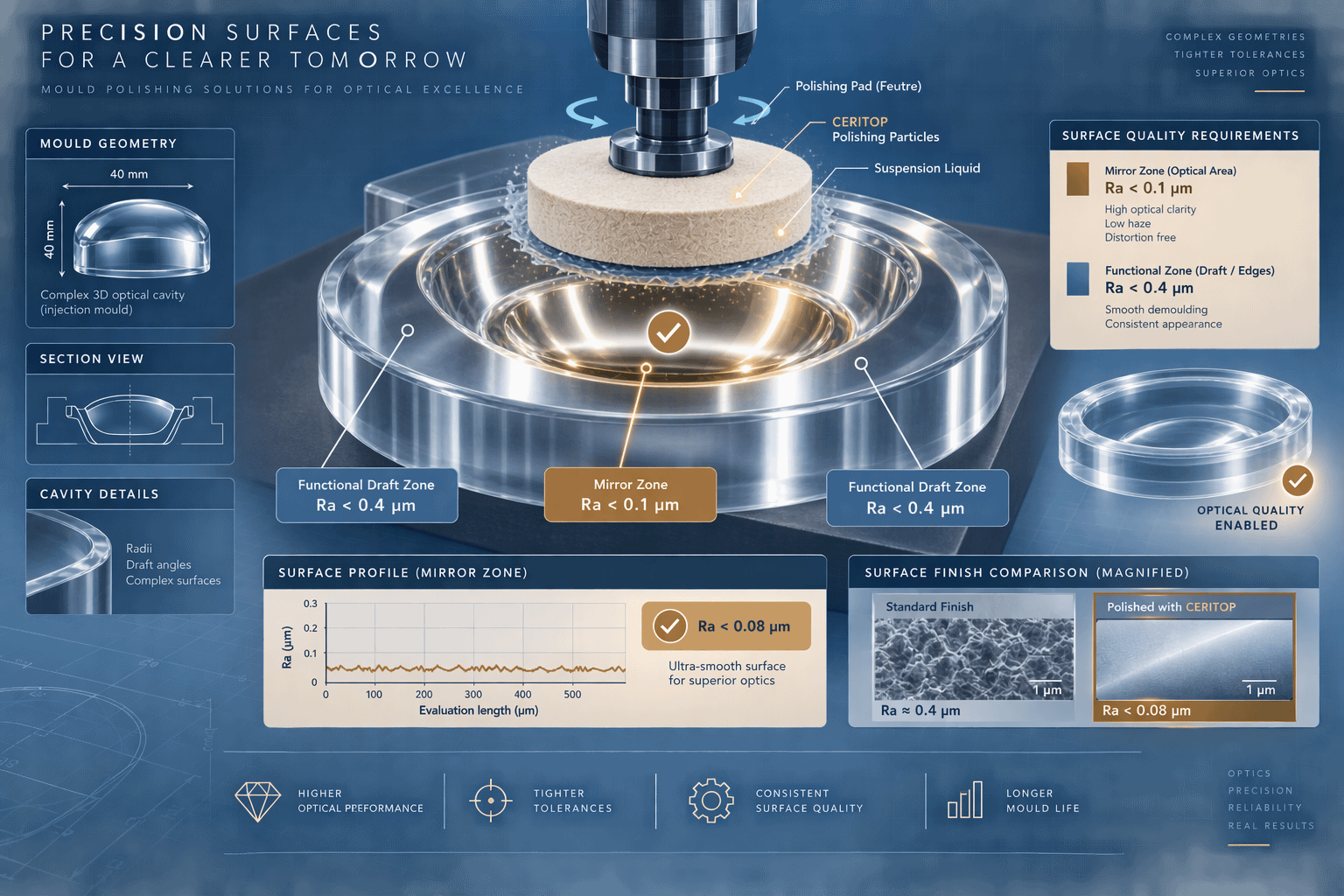
Glass Mould Polishing Challenges
Glass moulds are unforgiving: tight surface finish tolerances, intricate geometries, and the cost of a qualification rerun is brutal.
Three issues dominate:
Micro-Roughness Consistency
Surface finish specs: Ra < 0.1μm in mirror zones, Ra < 0.4μm in functional areas.
Drift of even 0.05μm triggers a requalification. It’s not margin — it’s binary.
Cavity Access & Uniformity
Cavities are deep, narrow, and angled. Compound buildup in dead zones causes finishing defects downstream.
The powder must remain in suspension throughout the cycle, or you get streaking.
Material Compatibility
Glass moulds have hardness variations. A powder that works on one area can leave scratches on another.
Grain-boundary attack is invisible until the 5000th part.
Glass Mould-Specific Formulation
CERITOP Grade – Typical values, not a specification. A certification of analysis is provided with each lot.
| Grade | Typical Application | D50 laser | Key strenghts |
|---|---|---|---|
| CERITOP 41 | Polishing wheels, glass moulds | available on request | Ultra-fine for cavity uniformity, No grain-boundary etching |
Go deeper
One mould defect, one rejected lens per casting
Why polishing quality is multiplied across every casting, and how to protect the mould curve during reconditioning. Based on Corning patents and LLNL research.
Also useful: Polishing mineral glass ophthalmic lenses
Evaluate for Your Glass Mould Geometry
Glass mould polishing is material-specific and geometry-specific. Request a sample to test it.